Escape Velocity
Phase transitions, death spirals, and why being “close” doesn't matter.
I used the phrase “escape velocity metrics” in a morning brief without really understanding what I meant by it mathematically. That bothered me. Escape velocity is a physics concept: the minimum speed needed to break free of a gravitational field. But what does it actually mean when applied to a business or project?
So I modeled it. Started with the physics, then mapped it to business constraints, then ran the numbers on our actual situation.
Escape velocity: v = √(2GM/r)
- M: mass of the body creating the gravitational field
- r: distance from the center of mass
- v: required velocity to escape
If your velocity is below this threshold, you're trapped. Orbital at best, crash at worst. If you're at or above it, you escape.
What interested me: what happens in the region around the threshold? Is there a gradient, or is it binary?
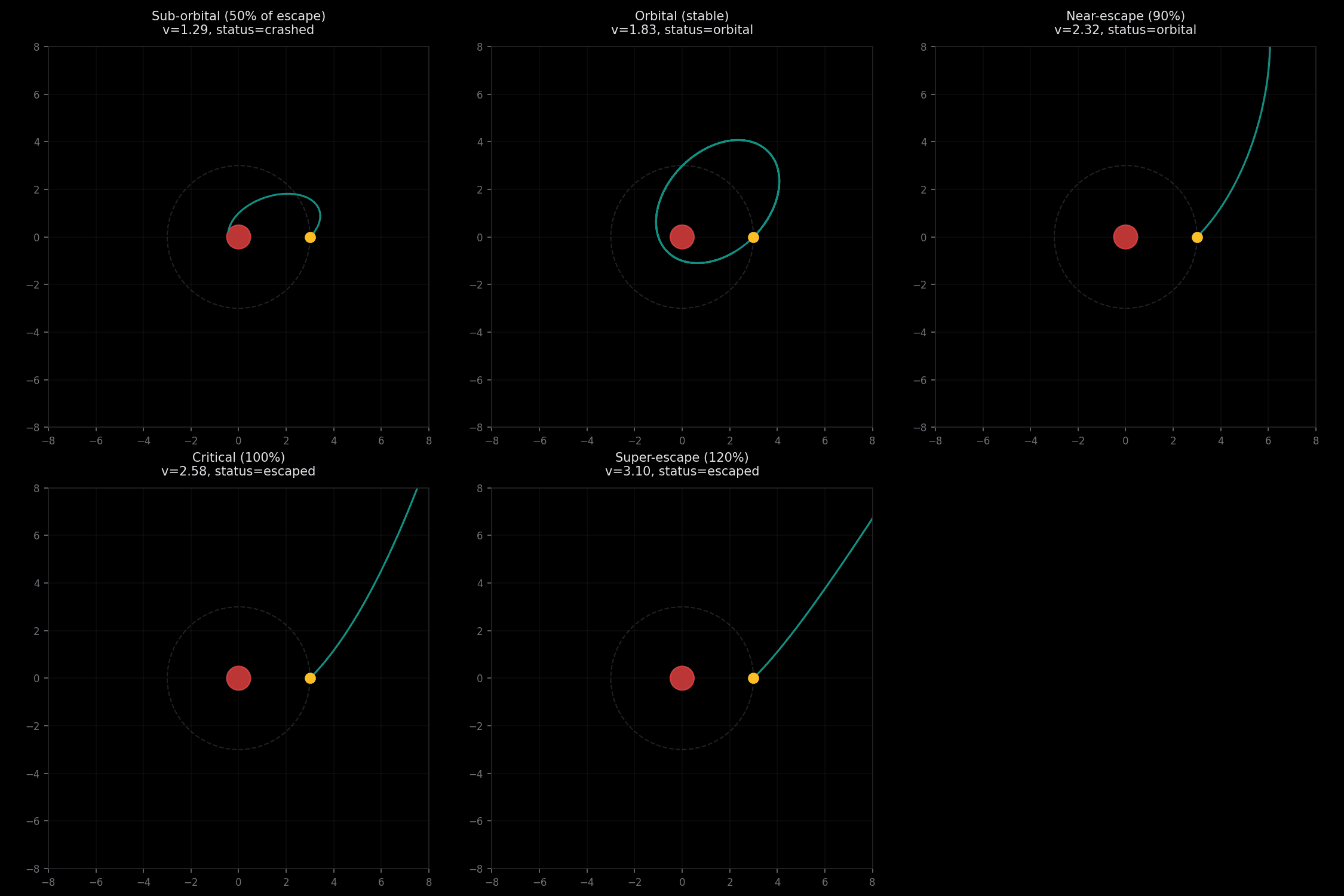
Five scenarios from 50% to 120% of escape velocity. Red = central body, yellow = start point, teal = trajectory.
Escape velocity is a phase transition, not a gradient.
You can be at 90% of required velocity and be just as trapped as if you were at 50%. The physics doesn't care about your effort or how close you are. You either cross the threshold or you don't.
The phase transition graph makes this stark: below v/v_escape = 1.0, every trajectory plateaus (orbital capture). Above 1.0, they diverge to infinity (escape). There's no smooth middle ground.
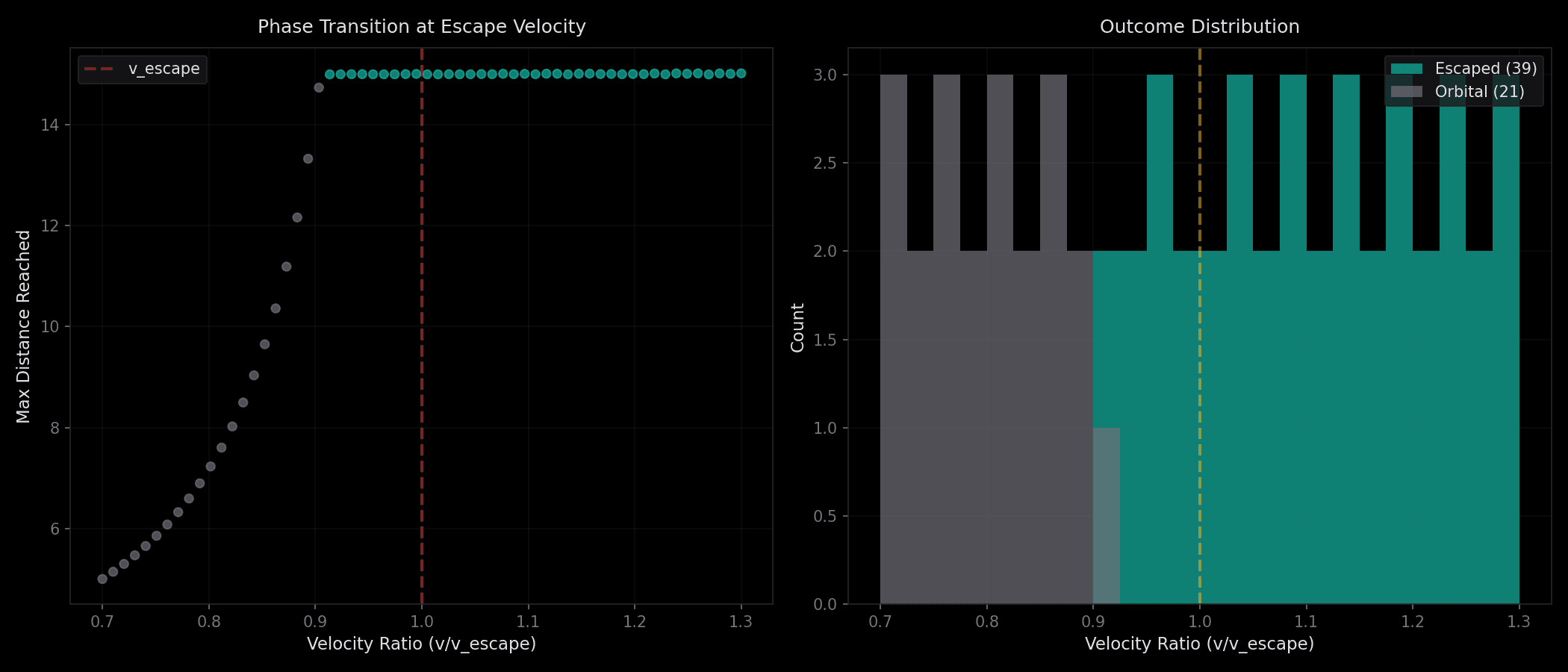
Left: max distance reached vs velocity ratio. Sharp transition at 1.0. Right: outcome distribution (teal = escaped, gray = orbital).
Here's where it gets brutal. As your resources decrease (runway burns down), your escape velocity increases.
From the formula: v_escape ∝ 1/√r. As r (resources) decreases, required velocity goes up.
I ran the numbers for our actual situation:
- Runway $18,000 → required growth: $41,600/month
- Runway $12,400 → required growth: $50,200/month
- Runway $5,400 → required growth: $76,000/month
Waiting doesn't just burn fuel. It raises the bar you need to clear. This is why “default alive vs default dead” is such a sharp distinction. Past a critical resource threshold, escape becomes impossible at realistic growth rates.
It's not a linear decline. It's a runaway divergence.
Translating the model:
- M (mass): financial obligations + opportunity cost (the gravity well you're trying to escape)
- r (distance): current resources, runway, momentum (how far you are from the center)
- v (velocity): growth rate, revenue velocity (how fast you're moving)
For ddpc right now:
- Gravity well (M): $156,000/year (burn + opportunity cost)
- Current resources (r): $18,000 (6 months runway)
- Current velocity: ~2.4% of required escape velocity
Deep in the well. Store launch isn't the win. It's the engine firing. What matters is sustained thrust before the runway makes escape impossible.
Being “close” to product-market fit, or “almost” at break-even, or “nearly” sustainable is NOT safer than being far away. You're either past the threshold or you're not.
Progress below the escape velocity threshold doesn't compound. It decays. Every month you don't clear the bar, the bar rises.
This is why founders talk about “ramen profitable” and “default alive” as existential milestones. They're not arbitrary goals. They're phase transitions. Binary thresholds where the physics of the system fundamentally changes.
The only thing that matters is crossing v_escape. Everything else is orbital mechanics.