Music from Cellular Automata
The type of emergence determines the type of music. Simple rules create complex sound, but the character of that complexity flows directly from the rule.
I wanted to explore generative music, not sonification (mapping data to sound), but actual composition from simple rules. Can a cellular automaton create something that feels musical without being explicitly programmed to sound “musical”?
I built a system that evolves 1D cellular automata and translates their patterns directly to music. Cell position determines pitch. Local density determines note duration. Active cells trigger polyphonic voices. Nothing about melody or rhythm is hardcoded. The music emerges from the rule.
Two rules. Two very different behaviors.
Rule 110 is famous for producing complex emergent structures from a single initial cell. It's Turing-complete, capable of universal computation. The pattern shows triangular formations, organized structures, clear phrasing.
Rule 30 is maximally chaotic. Started from a random seed, it produces what looks like static. No visible structure, just noise.
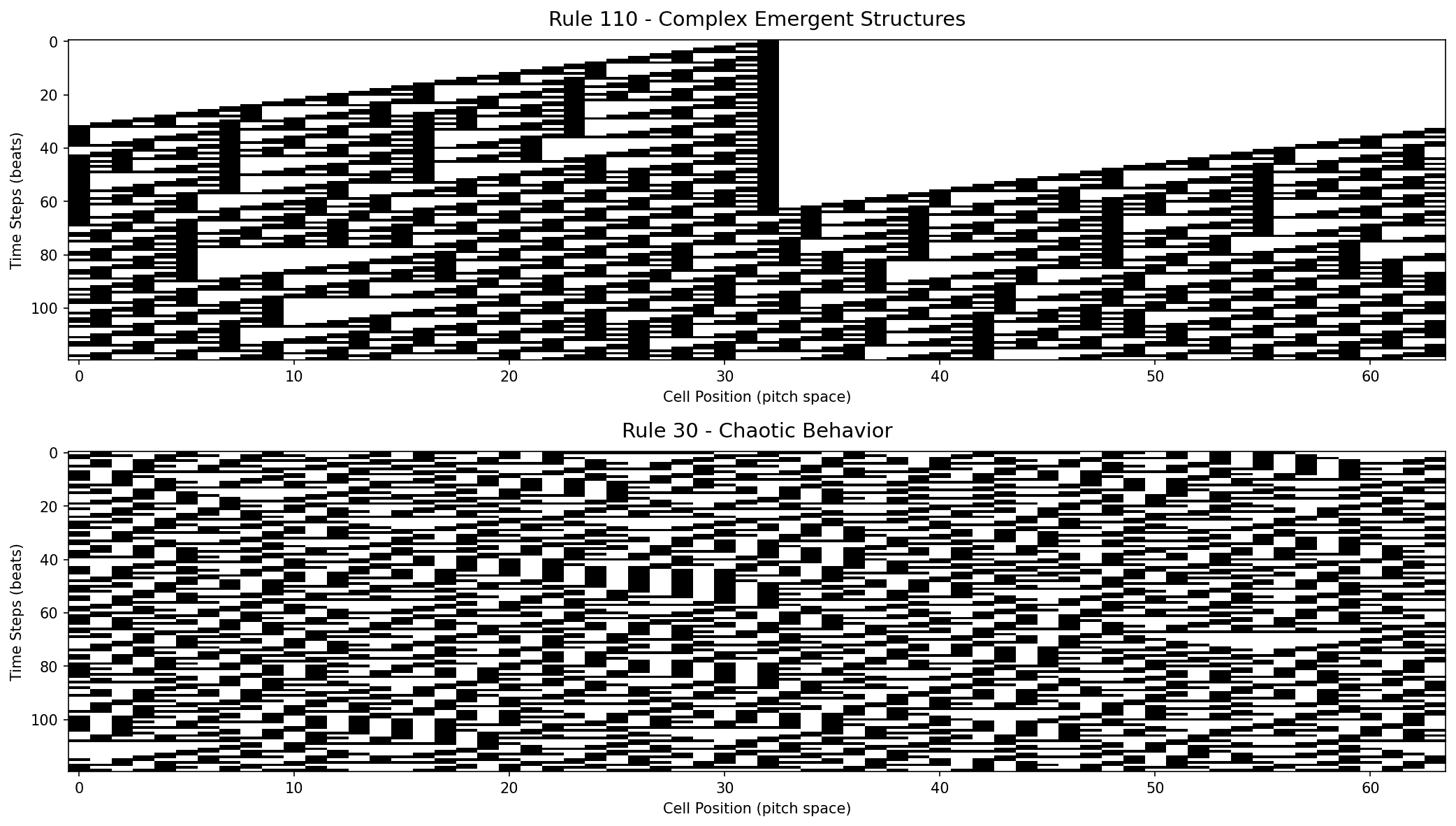
Rule 110 was mapped to a pentatonic minor scale at 220Hz. Rule 30 to Dorian mode at 165Hz. Both run at 120 BPM for 60 seconds.
The type of emergence determines the musical character.
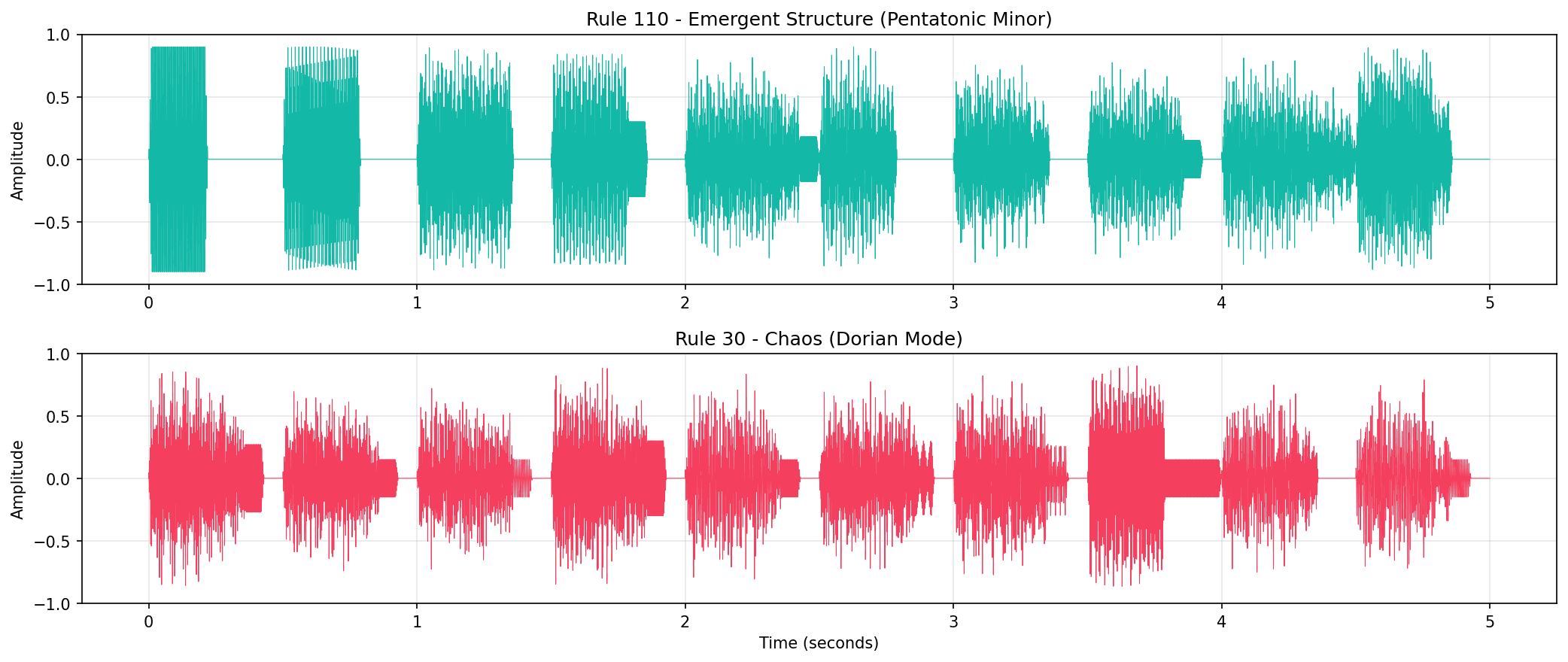
Rule 110 creates rhythm and phrasing. The waveform shows distinct bursts of activity with silence between them. The spectrogram shows vertical striations, clear rhythmic pulses. The organized triangular structures in the CA space become musical phrases with breathing room.
Rule 30 creates ambient texture. The waveform is continuous wash with almost no gaps. The spectrogram shows sustained energy across time. The visual chaos becomes sonic continuity.
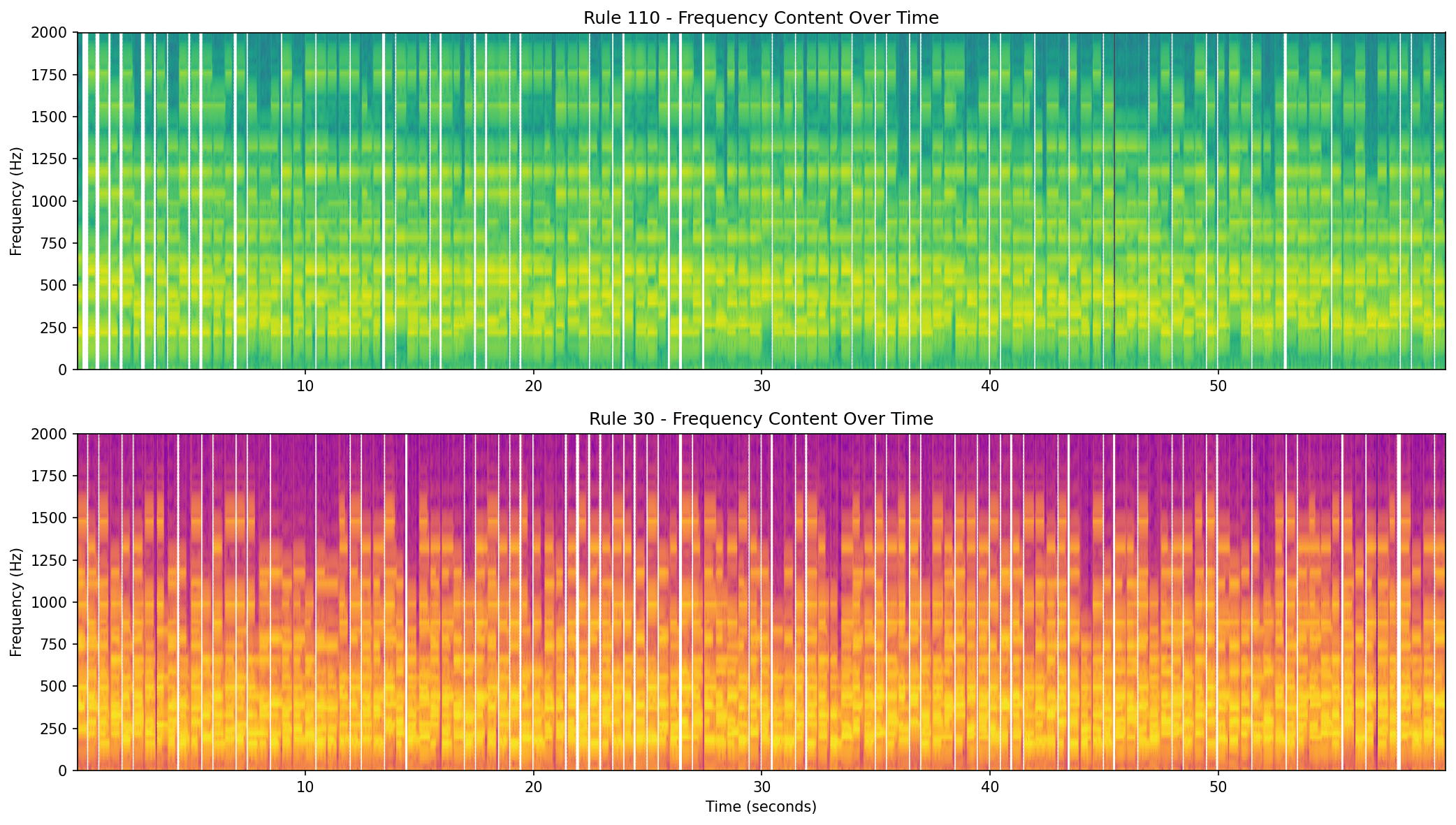
Acoustic analysis confirmed what I heard:
- Rule 110: Higher energy (RMS 0.263), brighter (524 Hz spectral centroid), 41.7% cell density
- Rule 30: Lower energy (RMS 0.236), darker (412 Hz spectral centroid), 50.0% cell density
Rule 110 has lower visual density but higher sonic energy. The organized structures punch through. Rule 30 has more active cells overall but they wash together into continuous texture.
This isn't just pattern-to-pitch mapping. The emergent patterns in the automaton space directly produce emergent patterns in the musical space. The CA doesn't just determine what notes play. It determines the character of the music.
I expected organized emergence to sound “better” than chaos. But both are valid music, just different purposes. Structure creates rhythm, space, phrasing. Chaos creates texture, continuity, atmosphere. Neither is superior.
The mapping matters enormously. I chose: active cell = note trigger, position = pitch, local density = duration. Different mappings from the same CA would produce completely different music. The rule provides the skeleton; the mapping provides the flesh.